
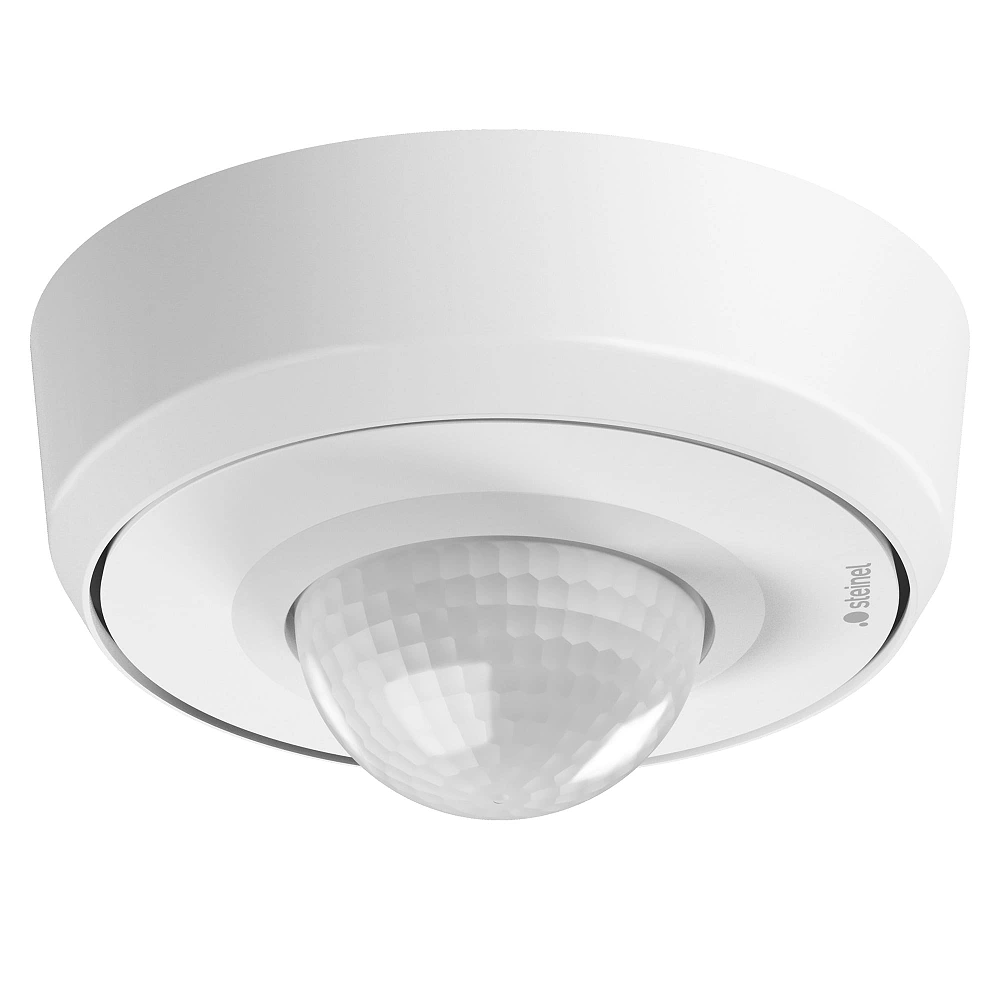
STEINEL MD-24 ECO COM1 AP surface ceiling motion sensor 360°, Ø24 m, IP54, white (087760)

- Indoor lighting
- Outdoor lighting
- Technical lighting
- LED bulbs
- LED strips and profiles
- LED power supplies
- Motion sensors and dusk switches
- Motion sensors
- Other
- Sale
Your shopping cart is empty!
Item specifics
- Housing material Plastic
- Weight 257 g
- Number of detection zones 1436
- Sensor type Passive infrared (PIR); movement and ambient-light measurement
- Installation Ceiling indoors; surface-mounted AP installation
- Reach At 2.5 m height per manual: tangential Ø24.5 m; radial Ø5.5 m. Product page nominal tangential zone: Ø24 m.
- Detection angle 360°
- Optimal mounting height 2.8 m
- Maximum mounting height 4 m according to installation manual
- Time setting 5 s–60 min
- Twilight setting 2–1000 lx; Teach; daylight mode
- Segment masking Supplied lens shroud; cut to suit required segments
- Manual control Push-button input; button cable <50 m; up to 4 h manual override ON
- Relay load Incandescent/halogen: 2000 W; low-voltage halogen: 2000 VA
- LED load (W) LED/electronic ballasts: 500 W; max. 50 units; C<176 µF
- Parallel connection Wired via L′; up to 10 sensors
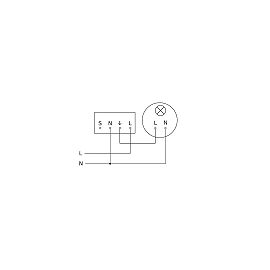
- Output type COM1; one switched-live relay, ON/OFF
- Interface & control COM1 relay; push-button input; fully or semi-automatic mode
- Settings Potentiometers; optional RC8 or Smart Remote
- Voltage 220–240 V AC, 50/60 Hz
- Operating temperature −20…+50 °C
- IP rating IP54
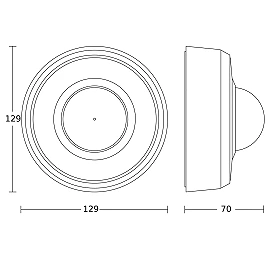
- Dimensions (W×H×D) Ø129 × 70 mm (diameter × height)
- Accessories Optional: RC5 (592806), RC8 (559410), Smart Remote (009151)
- Warranty 5 years
- Colour / RAL White
- In the box Sensor, lens shroud, safety information and quick-start guide; remote not included
- Manufacturer SKU 087760
- EAN 4007841087760
- Standby power consumption (W) <0.1 W
Product Description
Wider movement coverage for indoor lighting
STEINEL MD-24 ECO COM1 AP is a white surface-mounted ceiling motion detector for indoor spaces requiring a broader movement detection area. Its passive infrared sensor detects moving heat sources, while the light measurement enables automatic switching to follow the room's brightness. Typical uses include shared passages, ancillary areas and larger rooms with regular movement. The AP housing mounts on the ceiling surface, creating a central switching point for the connected lighting circuit. This is a motion detector intended to respond to movement through its field of view.
The MD-24 model combines 360° coverage with a broad tangential detection area. Its product page identifies the Ø24 m class; the installation manual gives a tangential diameter of Ø24.5 m at a mounting height of 2.5 m. The radial zone for movement towards the detector is smaller, at Ø5.5 m. These describe different directions of travel, so the largest diameter should not be interpreted as equal sensitivity everywhere. Positioning the detector so that normal walking routes cross its detection sectors helps put the available coverage to practical use, particularly in a larger room.
PIR detection needs an unobstructed view of the movement area: walls and glass block the heat radiation used to detect movement. The supplied adjustable lens shroud can restrict unwanted sectors, such as an adjacent route that should not trigger this lighting circuit. Test mode and the indicator LED help check the response after installation, before everyday settings are finalised. A coverage check is also useful after furniture is rearranged or the way the room is used changes.
Timing, light level and push-button control
The stay-on time can be set from 5 seconds to 60 minutes, allowing a shorter delay for a passage or a longer period where someone needs time after entering. A 2–1000 lx twilight threshold adapts the switching response to available daylight. Teach stores the light level measured at the installation: activate it at the brightness you want to use, and the reading is accepted after ten seconds. Daylight operation is also available, allowing movement to switch the load regardless of ambient brightness.
In fully automatic mode, the detector switches the lighting on and off according to the selected settings. In semi-automatic mode, a connected push-button is used to switch on, while switching off remains automatic. This is useful where occupants should decide whether they need artificial light. The push-button input also permits manual operation and a four-hour continuous-on period. The detector can return to its normal sensor operation after the selected action; the manual explains the relevant button sequence and how to end an override.
Potentiometers provide basic adjustment. Optional RC8 and Smart Remote controls offer remote configuration. Smart Remote is a separate accessory used with the manufacturer's app on a phone or tablet; a remote is not supplied with this detector. This arrangement makes it possible to revise timing, the light threshold or operating mode after the room is in service without physically reaching the ceiling unit for every change. The RC5 accessory provides convenient user functions such as the temporary manual override.
COM1 switching and surface installation
COM1 provides one relay output for switching lighting on and off. The detector uses a 220–240 V AC supply. A wired parallel connection can combine up to ten compatible sensors to extend the monitored area. The permitted LED/electronic-ballast load is 500 W, subject simultaneously to a maximum of 50 units and total capacitance below 176 µF. These limits must be considered together when selecting lamps and control gear. The magnetic module connection helps attach the sensing part to the mounting assembly after the wiring is prepared.
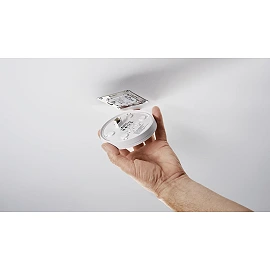
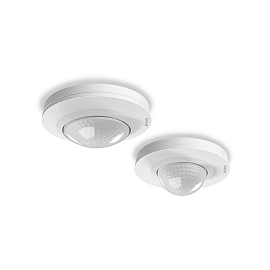
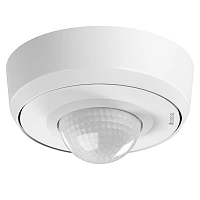
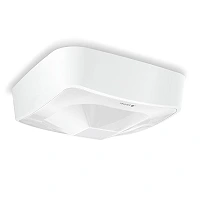
The surface-mounted AP housing has IP54 protection, and the manufacturer's installation instructions specify ceiling mounting indoors. The manual gives an installation range of 2.5–4 m and an optimum height of 2.8 m. The wiring diagram and dimension drawing help plan the installation. The mounting photograph and two-detector overview in the gallery illustrate other mounting versions within the ECO family; the main image shows the AP housing supplied in this listing.