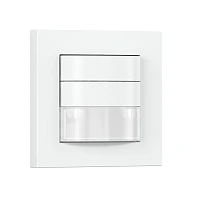
STEINEL HF 180 KNX V3.1 wall presence detector, HF 5.8 GHz, 180°, up to 8 m, IP20, white — 059460

Item specifics
- Dimming method KNX control; separate compatible dimming actuator required
- Weight 84 g (net)
- Detection angle 180°
- Optimal mounting height 1.2 m
- Maximum mounting height 2.2 m
- Time setting Lighting channels: 1–255 min; IQ mode
- Twilight setting Separate KNX photocell controller: 10–2000 lx; independent of presence
- Sneak-by guard Yes
- Segment masking No; electronic reach adjustment
- Manual control Integrated pushbutton; ETS-configurable function
- Output type KNX telegrams; external actuator for luminaire load
- Interface & control KNX TP 256; integrated bus coupling; KNX Secure: no
- Settings ETS; KNX bus; optional RC6/RC7/Smart Remote
- Colour / RAL White / RAL 9010
- Manufacturer SKU 059460
- EAN 4007841059460
- Sensor type HF — high frequency, 5.8 GHz
- Motion detection Tangential and radial r ≤ 8 m
- Application Indoors
- Installation Concealed mounting; wall installation box; concealed wiring
- Installation height 1.2–2.2 m
- Light-level setting 2–1000 lx; Teach
- Voltage KNX bus (SELV); not 230 V
- Functions 4 logical lighting channels; constant-lighting control; basic brightness; temperature; humidity; presence/HVAC telegrams
- Housing Plastic
- IP rating IP20; indoor use
- Dimensions Depth × width × height: 50 × 80 × 80 mm
- Temperature range 0…+40 °C
- Warranty 5 years — manufacturer terms
- Incoming current 12.5 mA
- RF frequency 5.8 GHz; transmitter power <1 mW
Product Description
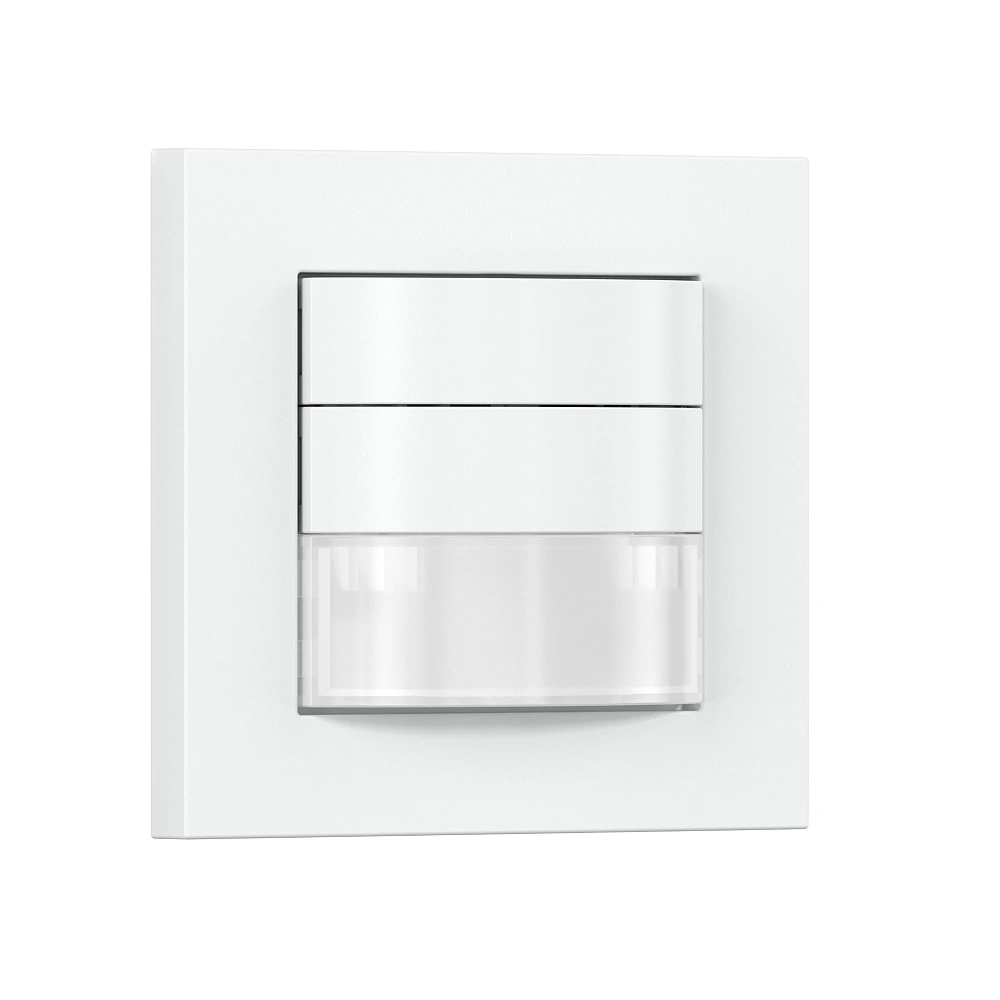
STEINEL HF 180 KNX V3.1 is a white concealed-wall presence detector for rooms where KNX controls lighting and other building functions. High-frequency detection responds to movement, while brightness, temperature and humidity readings provide additional information for room automation. An integrated pushbutton preserves manual control, with its function assigned through ETS. This listing covers article 059460, the KNX version. A similar-looking COM1 detector uses a different power supply and a physical relay output, so electrical compatibility cannot be established from the exterior alone.
The active 5.8 GHz HF system transmits a low-power signal and evaluates changes in the returning echo. Movement detection does not depend on the temperature contrast between a person and the surroundings. The sensor provides a 180° detection angle, with a manufacturer-specified radial and tangential reach of up to r = 8 m. Depending on the material and its thickness, detection can extend through glass, wood and lightweight partitions. This can be helpful in rooms containing cubicles, but it also means that movement outside the intended lighting zone may influence operation. Adjust and test the detection range in the actual room rather than assuming a partition always stops the signal.
The detector is intended for concealed wall installation at 1.2–2.2 m, with 1.2 m as the optimum mounting height. Its front measures 80 × 80 mm and overall depth is 50 mm. The plastic housing is white RAL 9010. Applications include an individual office, entrance area, corridor, stairwell or washroom with suitable installation conditions. The IP20 enclosure is intended for indoor locations within the stated 0–40 °C ambient range. Choose another protection rating where direct exposure to water is possible. Before installation, check the wall box, cable entry and mounting position against the product dimensions and the required detection area.
Power is supplied by the KNX safety extra-low-voltage bus, with the bus coupling already integrated. The detector must not be connected directly to a 230 V mains supply. It sends KNX commands, while a separate suitable actuator handles the luminaire load. Dimming and constant-lighting control operate through bus values and require a compatible dimming actuator, luminaire and driver. Four logical lighting channels allow the project to address several lighting groups, but they do not represent four physical relays inside the sensor. Individual group functions and operating modes are determined by the ETS application and by the capabilities of the connected control equipment.
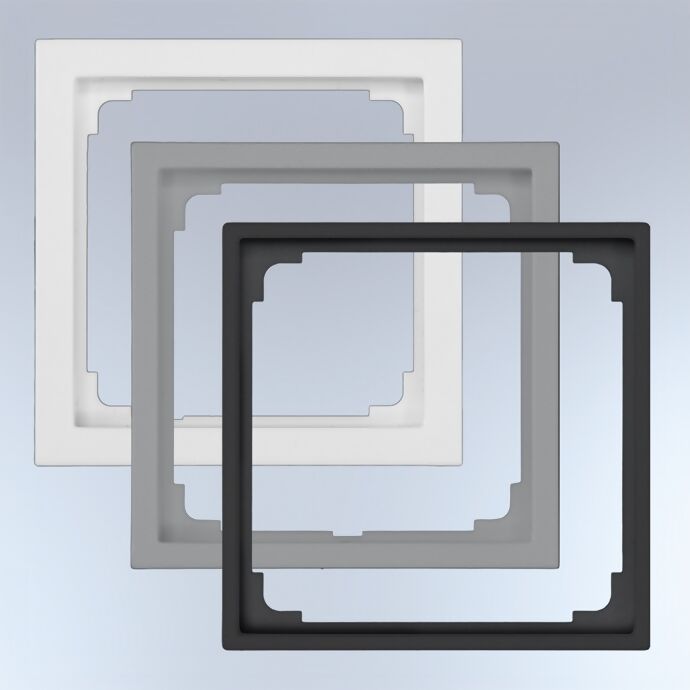
The brightness threshold is adjustable over 2–1000 lx and lighting-channel stay-on time over 1–255 minutes. IQ mode and basic-brightness control are also available. Temperature and humidity readings can be transmitted to other KNX devices, while occupancy information can form part of the heating, ventilation or air-conditioning logic configured for the installation. The manual pushbutton can be assigned to lighting commands or another supported task. After programming, test movement both in front of the detector and behind nearby lightweight partitions, then choose suitable range and sensitivity settings. Optional RC6, RC7 and Smart Remote accessories are separate purchases. Adapter frames for alternative switch systems are also optional, and compatibility must be checked against the precise switch manufacturer, product series and adapter article. The accessory photograph illustrates available frame options, rather than additional items included with the detector.
In addition to occupancy-based lighting, the KNX application provides a separate photocell controller function that operates independently of whether people are present. This separate output has a 10–2000 lx threshold. It sends a bus command when the measured room brightness falls below the selected value, with an external KNX actuator still handling the connected load. Its threshold should therefore be distinguished from the 2–1000 lx occupancy-lighting threshold.