
Steinel
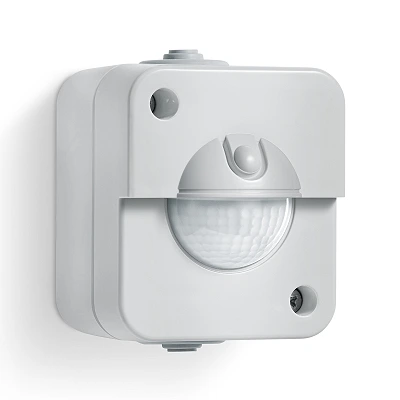
STEINEL IR 180 UP easy concealed PIR sensor switch, 180°, up to 8 m, IP20, white
94.50€Bez PVN: 78.10€

Your shopping cart is empty!
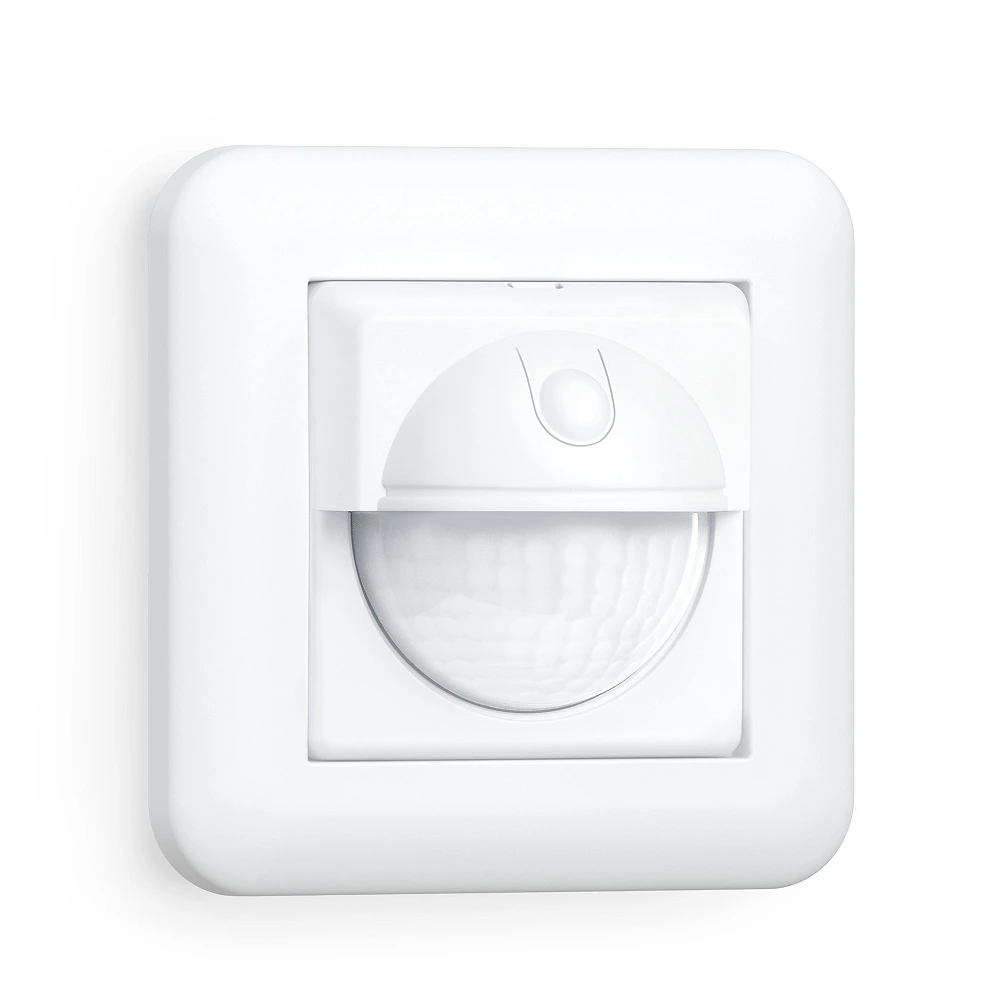
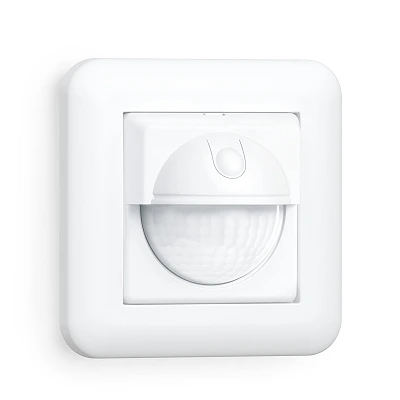
STEINEL IR 2180 UP ECO is a white flush-mounted sensor switch for automatic lighting in corridors, stairwells, toilets and utility rooms. Article 065003 fits a wall installation box and combines a motion-sensing lens with a button for manual operation. It controls a separate lighting circuit at mains voltage; it is not a luminaire and does not contain a replaceable lamp. The compact front surround places automatic control where a conventional wall switch would normally be used.
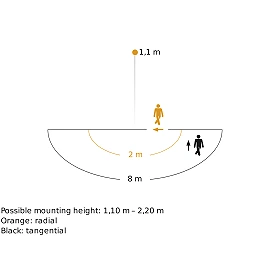
The passive infrared sensor detects changes in heat emitted by moving people over a 180° field. The manufacturer specifies up to 8 m tangential reach for movement across the sensor and up to 2 m radial reach for movement towards it. The position beside a doorway should therefore be considered together with the usual walking direction. A 90° angle of aperture, 96 switching zones and detection below the sensor cover the intended approach area, but walls and glass obstruct the infrared signal.
The optimum mounting height is 1.1 m, within the current data sheet's 1.1–2.2 m range. The product does not provide individual segment masking or electronic or mechanical reach scaling. A walk test after installation, using daylight mode and a short time setting, helps confirm that the actual route through the room is covered. Heat changes from lighting within the detection area can produce unwanted switching and should be considered when choosing the position.
The local controls set the brightness threshold from 2 to 1000 lux and the stay-on time from 5 seconds to 30 minutes. Further movement restarts the selected delay. After the light switches off, the sensor pauses for approximately six seconds before it can respond again. This behaviour suits spaces used for limited periods, where somebody needs light while passing through or working briefly and an unattended lighting circuit would otherwise remain switched on.
The front button allows the user to change the light state, including switching on when daylight would normally inhibit automatic activation. The manual describes a subsequent return to sensor control according to movement, elapsed time and ambient brightness; this is not a fixed four-hour forced-on mode. The status LED can be disabled. These local controls provide a direct way to adjust or override the automatic response without requiring a separate control unit.
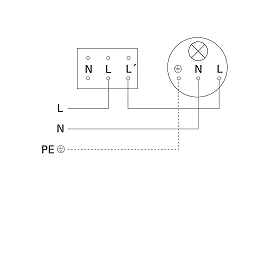
The switch uses 220–240 V AC at 50–60 Hz and supports two-wire and three-wire installations. Without a neutral conductor N at the switch, the manual specifies a minimum connected load of 4 W. Connecting N reduces that minimum to 1 W. The L′ terminal supplies the switched mains phase to the luminaire. Before replacing an existing switch, an electrician should check the available conductors, the lighting load and the installation box rather than relying on the appearance of the front surround alone.
If an LED lamp flickers or glows when switched off in a circuit without N, the manual advises adding the neutral connection or changing the lamp. The sensor switches the lighting circuit rather than regulating its brightness. It can therefore automate conventional on/off lighting while retaining a manual button, but lamp compatibility still depends on the electrical load, driver behaviour and wiring arrangement. The minimum load and maximum ratings must both be respected.
The model-specific manual 110068641, dated January 2025, gives a 2000 W incandescent/halogen rating and a 350 W LED/electronic-ballast rating, with no more than 50 units and total capacitance below 132 µF. The current data sheet provides lower LED limits according to the power of each lamp: 40 W below 2 W per lamp, 100 W above 2 W and below 8 W, and 160 W above 8 W. Those lower limits are used here for LED selection. The manual's 350 W figure is not presented as a universal LED allowance, and lamp count and capacitance remain relevant alongside total wattage.
The manual also describes brightness Teach mode and the parallel connection of up to five sensor switches, requiring N at every switch without increasing the total permitted load. However, the current data sheet marks both Teach and interconnection as unavailable. Check the instructions supplied with the actual device before relying on either function. The physical setting controls and manual button are the consistent basic functions; the conflicting entries are disclosed instead of being turned into an unconditional feature claim.
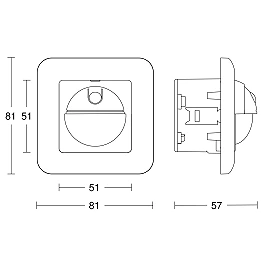
The plastic finish is white RAL 9010. With IP20 protection, this model is intended for dry indoor areas at 0 to +40°C. The manual gives overall dimensions of 81 × 81 × 57 mm in height, width and total depth order. The 57 mm overall depth should not automatically be treated as the depth of the part inside the wall. Net weight is 113 g. The supplied product comprises the sensor module, load module and surround; the installation position and wall box should be checked against the complete manufacturer drawing.
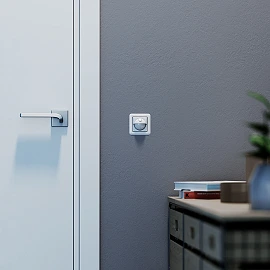
The manufacturer supplies a shared UP easy housing-family installation photograph on the IR 2180 UP ECO page; functions are specified from the 065003 documentation.
Apskatiet citas izvēles iespējas un šai precei piesaistītos produktus.
Steinel
Steinel