STEINEL True Presence COM1 UP concealed ceiling presence detector, HF 7.2 GHz, 360°, Ø9 m True Presence, Bluetooth Mesh, IP20, white — 085575

- Indoor lighting
- Outdoor lighting
- Technical lighting
- LED bulbs
- LED strips and profiles
- LED power supplies
- Motion sensors and dusk switches
- Motion sensors
- Other
- Sale
Your shopping cart is empty!
Item specifics
- Weight 164 g
- Detection angle 360°; aperture angle 160°
- Time setting 30 s–60 min per manual; current table lists 20 s minimum; pulse 2 s/8 s
- Sneak-by guard Yes
- Segment masking No individual segment masking or mechanical adjustment
- Manual control S pushbutton input, cable <50 m; compatible Bluetooth Mesh buttons; ON/OFF and timed commands
- Relay load Resistive 2000 W; electronic ballasts 600 W per manual; low-voltage halogen 2000 VA; fluorescent: uncorrected 1000 VA, series-corrected 400 VA, parallel-corrected 1000 VA
- LED load (W) 100 W (LED<2 W); 300 W (2<LED<8 W); 600 W (LED>8 W); max. 8 LED/fluorescent lamps; 176 µF
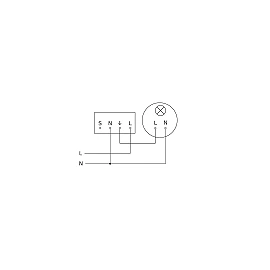
- Output type One COM1 switched-live relay output; non-floating; no dimming
- Interface & control COM1 relay; Bluetooth Mesh groups and neighbouring-group function
- Settings STEINEL Connect app via Bluetooth
- Colour / RAL White; RAL 9003
- In the box True Presence UP sensor, safety information and quick-start guide; alternative colour and external system accessories not included
- Manufacturer SKU 085575
- EAN 4007841085575
- Sensor type High-frequency True Presence sensor; micro-movement detection
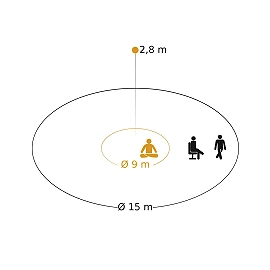
- Presence detection zone True Presence micro-movements Ø9 m (64 m²), mounting height up to 4 m; ordinary presence Ø15 m (177 m²)
- Motion detection Radial and tangential up to Ø15 m (177 m²)
- Sensor system Electronic range adjustment in app; 9 scenarios, 1 and 2 without True Presence
- Application Indoors
- Installation Ceiling, concealed-wiring UP; load module screwed onto a mounting box
- Installation height 2.8–12 m per manual; current table 2–12 m; optimum 2.8 m; True Presence up to 4 m
- Light-level setting Onboard light measurement; 2–2000 lx, Teach, daylight mode
- Voltage 220–240 V AC, 50–60 Hz
- Parallel connections Bluetooth Mesh; master/master or master/slave; manual specifies up to 100 network devices
- Functions Automatic/semi-automatic, grouping, test, presentation mode, pulse
- Housing Plastic
- IP rating IP20; UP concealed-wiring version
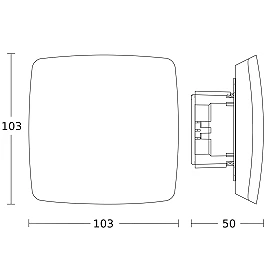
- Dimensions 103 × 103 × 50 mm (face width × height × overall depth including rear module); current white-model table lists 33 mm; exact drawing and manual show 50 mm
- Temperature range −20…+50 °C
- Warranty 5 years
- Wattage 1 W per current table; manual <1 W
- RF frequency True Presence 7.2 GHz; Bluetooth 2.4–2.48 GHz
Product Description
Presence detection during quiet activity
STEINEL True Presence COM1 UP is a white concealed-wiring ceiling presence detector that uses high-frequency sensing to detect very small human movements. It suits rooms where people sit, read, work at a computer or take part in meetings without making large movements. 7.2 GHz True Presence technology analyses micro-movements, including body movement caused by breathing. Choosing an appropriate detection area and sensitivity scenario helps lighting follow how the room is actually occupied, while retaining a defined relay response after people leave.
Two different detection areas need to be considered when planning the installation. True Presence micro-movement detection reaches up to Ø9 m, approximately 64 m², while movement and conventional presence detection extend to Ø15 m, or 177 m². The manufacturer's reference mounting height is 2.8 m, and the special True Presence function is intended for heights up to 4 m. The current table lists 2–12 m mounting while the manual specifies 2.8–12 m; this listing uses the manual baseline for planning. The greater mounting height does not mean breathing-related micro-movements are detected from a 12 m ceiling. Relating the required detection type to desks, seats and walking routes is a useful first step before selecting the sensor position.
Sensitivity and Bluetooth Mesh configuration
The detection area and sensitivity scenario are configured in the STEINEL Connect app. The manufacturer provides nine scenarios to accommodate quiet office work, more active spaces and environments affected by vibration. A small, quiet office needs a different response from an area containing moving machinery. Scenarios 1 and 2, intended for environments affected by vibration, disable the True Presence function and operate as conventional motion detection. This makes sensitivity a deliberate installation choice rather than an assumption that maximum sensitivity is appropriate everywhere.
Bluetooth Mesh allows the detector to operate individually or alongside compatible products in a lighting group. The app supports grouping, parameter adjustment and neighbouring-group functions, enabling the next lighting area to respond when required. The COM1 version provides one relay output for switching the connected circuit on and off. Fully automatic operation can follow room use, while semi-automatic operation requires a button press to turn the light on and leaves automatic switch-off to the detector. The S input accepts an external button, and compatible network buttons can also be assigned in the app.
The white model includes onboard light-level measurement with an adjustable 2–2000 lx threshold. This allows switching to take available daylight into account, so a presence signal need not turn lighting on in an already bright room. Teach stores the light level measured when the setting is selected. Daylight mode is available when the installation should respond to occupancy regardless of ambient brightness. This model switches a relay; the COM1 output does not adjust the brightness of the connected luminaires.
Timing, connected loads and concealed installation
The installation manual specifies a COM1 time range of 30 seconds to 60 minutes. The current product table also lists a 20-second minimum; the available settings for the actual unit can be checked in the app. Selecting an appropriate delay gives a predictable switch-off after the room is vacated. A button preserves manual control, while pulse mode provides a 2-second output followed by an 8-second pause, for example when triggering a compatible staircase timer. The selected function should match what the connected lighting circuit is intended to do.
LED loading depends on individual lamp power: 100 W total for lamps below 2 W, 300 W for lamps above 2 W and below 8 W, or 600 W for lamps above 8 W. The limit of eight LED or fluorescent lamps and the 176 µF capacitance limit apply at the same time. The current table lists 1500 W for electronic ballasts, while this listing uses the manual’s more conservative 600 W rating. Incandescent and halogen resistive loads are rated at 2000 W; that figure does not apply universally to LED lighting.
The UP model has a 103 × 103 mm face and a 50 mm overall depth including its rear load module. This concealed-wiring version is screwed to a suitable ceiling mounting box; 50 mm describes the complete product rather than a specified ceiling cutout or required box depth. The current white-model table lists 33 mm, while this listing uses the complete 50 mm assembly shown in the exact article drawing and manual. The white RAL 9003 finish suits light-coloured ceilings. The exact UP version has IP20 protection and is intended for indoor installation. It operates from 220–240 V AC, 50–60 Hz. High-frequency detection can respond through glass, wood or lightweight partitions, so electronic range adjustment helps limit unwanted responses from adjacent spaces. Choose a stable, vibration-free location; the manual requires at least 3 m separation from a Wi-Fi router or access point. After installation, check performance at the actual positions where occupants are expected to remain relatively still.
- 360° high-frequency presence detection with a separate micro-movement area.
- One COM1 relay circuit and Bluetooth Mesh configuration.
- Automatic or semi-automatic operation, button input and pulse mode.
- Indoor concealed ceiling installation with a RAL 9003 housing.
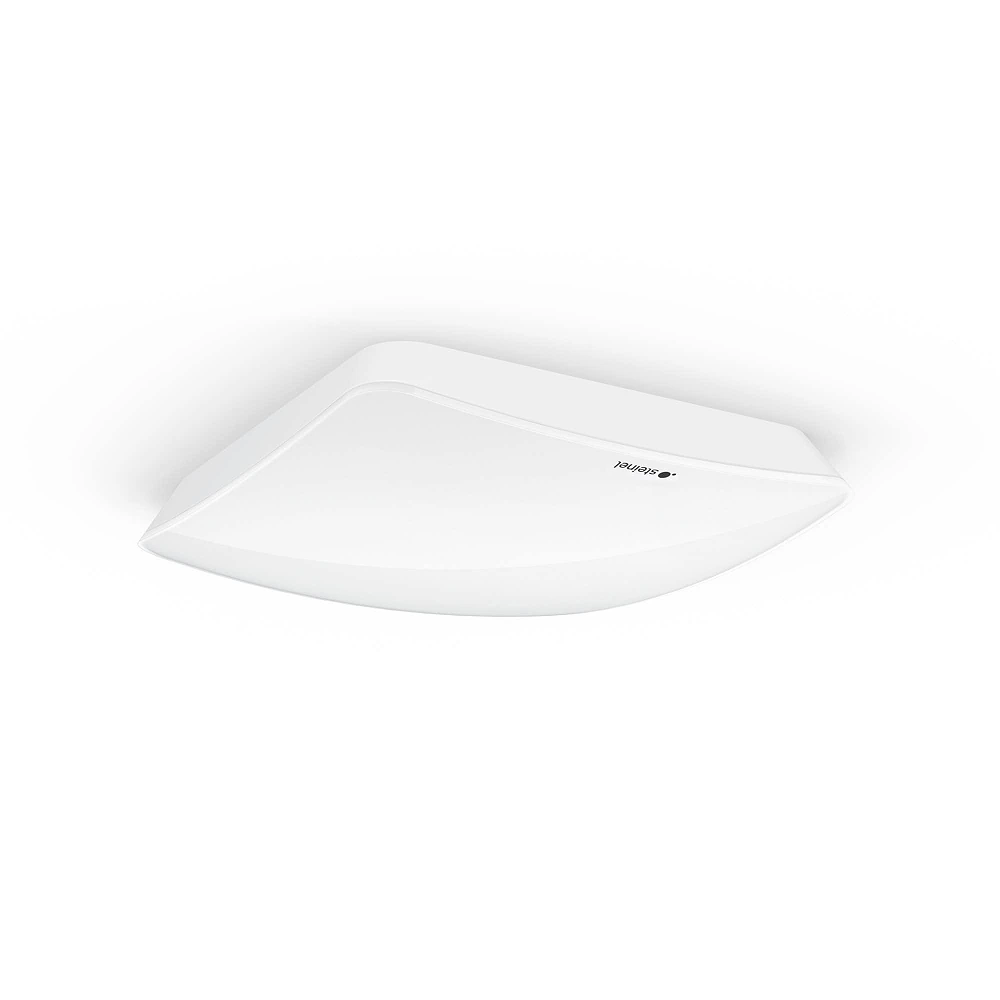
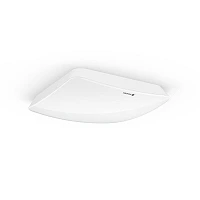
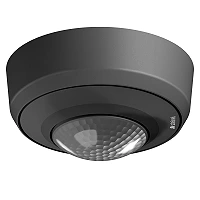
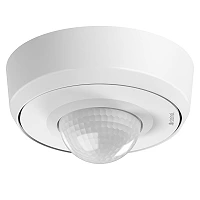
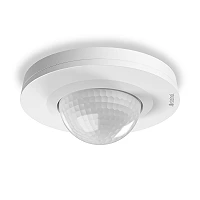
Image context. The first photograph shows the exact UP model offered here. The second product photograph shows the black COM1 UP family variant 085551 for comparison. It is a separate product and is not included with this offer; onboard light-measurement capabilities differ between the two colours. The remaining images are manufacturer detection, dimension and wiring diagrams rather than additional photographs.